This website is managed by Ultima Markets’ international entities, and it’s important to emphasise that they are not subject to regulation by the FCA in the UK. Therefore, you must understand that you will not have the FCA’s protection when investing through this website – for example:
You will not be guaranteed Negative Balance Protection
You will not be protected by FCA’s leverage restrictions
You will not have the right to settle disputes via the Financial Ombudsman Service (FOS)
You will not be protected by Financial Services Compensation Scheme (FSCS)
Any monies deposited will not be afforded the protection required under the FCA Client Assets Sourcebook. The level of protection for your funds will be determined by the regulations of the relevant local regulator.
Note: UK clients are kindly invited to visit https://www.ultima-markets.co.uk/. Ultima Markets UK expects to begin onboarding UK clients in accordance with FCA regulatory requirements in 2026.
If you would like to proceed and visit this website, you acknowledge and confirm the following:
1.The website is owned by Ultima Markets’ international entities and not by Ultima Markets UK Ltd, which is regulated by the FCA.
2.Ultima Markets Limited, or any of the Ultima Markets international entities, are neither based in the UK nor licensed by the FCA.
3.You are accessing the website at your own initiative and have not been solicited by Ultima Markets Limited in any way.
4.Investing through this website does not grant you the protections provided by the FCA.
5.Should you choose to invest through this website or with any of the international Ultima Markets entities, you will be subject to the rules and regulations of the relevant international regulatory authorities, not the FCA.
Ultima Markets wants to make it clear that we are duly licensed and authorised to offer the services and financial derivative products listed on our website. Individuals accessing this website and registering a trading account do so entirely of their own volition and without prior solicitation.
By confirming your decision to proceed with entering the website, you hereby affirm that this decision was solely initiated by you, and no solicitation has been made by any Ultima Markets entity.
Ultima Markets does not have an establishment in Singapore and does not operate from Singapore.
Ultima Markets does not provide products or services to citizens or residents of Singapore, and account applications from Singapore citizens or residents will not be accepted.
If you are a citizen or resident of Singapore, please do not open an account or use Ultima Markets’ products or services.
By selecting “Acknowledge and Continue Browsing”, you confirm that you are accessing this website on your own initiative and that your access is not the result of any direct marketing, targeted advertising, solicitation, or promotional activity by Ultima Markets.
Nothing on this website constitutes an offer, solicitation, or promotion of products or services in any jurisdiction where such activity is prohibited. You are responsible for ensuring that your access to and use of this website complies with applicable local laws and regulations.
What is margin trading? Learn how buying on margin works, how margin calls occur, and the key risks of using leverage in financial markets with examples.
Margin trading allows an investor or trader to control a position larger than the capital committed upfront. If you are asking “what is margin trading?” or “what is a margin?”, the key point is that margin is the cash or eligible collateral required to open and maintain a leveraged position. Gains and losses are calculated using the full position value, not only the margin deposited.
The structure depends on the product. Buying shares on margin normally involves borrowing part of the purchase price from a broker. With contracts for difference (CFDs) or futures, margin generally acts as collateral for a leveraged contract rather than a payment towards ownership of the underlying asset.
What Is Margin Trading?
Margin trading means using borrowed funds or deposited collateral to increase market exposure. This can improve buying power, but it also magnifies losses.
Product
How margin works
Common costs
Shares
The broker lends part of the purchase price, using account assets as collateral.
Loan interest and trading fees
CFDs and rolling spot forex
Margin supports a leveraged derivative position without ownership of the underlying asset.
Spread, commission and overnight funding
Futures
Margin acts as a performance bond supporting the trader’s obligations.
Trading fees and daily account adjustments
This distinction matters because not every margin trade is a conventional broker loan. FINRA describes securities margin as lending, while CME describes futures margin as a performance bond.
What Is a Margin?
A margin is the portion of a position’s value that must be provided to open or maintain a trade. It is usually expressed as a percentage:
Required margin = position value × margin rate
A £10,000 position with a 10% margin requirement needs £1,000 in margin. This is approximately 10:1 leverage because the trader controls ten times the deposited amount.
Margin requirement
Approximate leverage
50%
2:1
20%
5:1
10%
10:1
5%
20:1
If the £10,000 position moves by 5%, the gain or loss is £500 before fees. That equals 50% of the original £1,000 margin, showing how a relatively small market movement can have a large effect on account equity.
How Does Margin Trading Work?
A trader first opens an account that permits margin or leveraged positions. The broker sets an initial margin requirement according to the instrument, account type, market conditions and applicable rules.
Once a trade is open, unrealised gains and losses change account equity. If equity falls below the maintenance requirement, the trader may need to add funds, reduce the position or face closure. Platforms may also show used margin, free margin and margin level, although calculations vary between providers.
Understanding what is margin trading therefore involves more than knowing the opening deposit. Traders must also understand maintenance rules, financing costs and the broker’s liquidation process.
Buying on Margin: A Simple Example
Suppose an investor has £5,000 and uses buying on margin to purchase £10,000 of shares. The investor contributes £5,000, while the broker lends the remaining £5,000.
If the shares rise by 10%, the holding becomes worth £11,000. After accounting for the loan, the investor has £6,000, producing a £1,000 gain or a 20% return on the original capital before interest and fees.
If the shares fall by 10%, account equity drops to £4,000. The £1,000 loss equals 20% of the initial capital. The loan remains repayable, and interest may continue to accumulate. Investor.gov warns that buying on margin can produce losses exceeding the investor’s original contribution.
What Is a Margin Call?
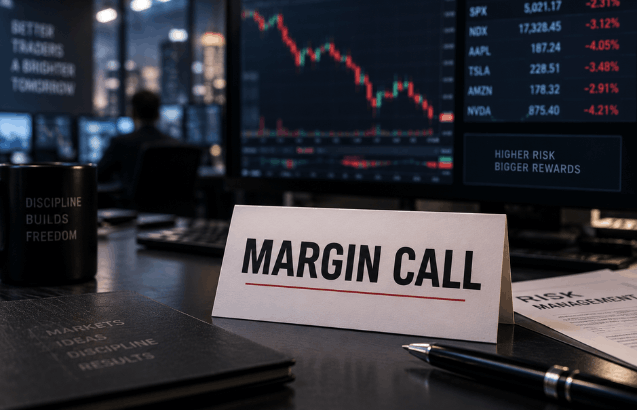
A margin call occurs when an account no longer meets its required equity level. It may be triggered by falling prices, a new trade that creates a deficit or a broker increasing its maintenance requirements.
Despite the name, a margin call does not always provide a guaranteed warning period. FINRA states that a US brokerage firm may sell securities without first issuing a call, may choose which assets to sell and may liquidate enough to repay the entire loan. Firms can also set requirements above regulatory minimums and raise them without advance written notice.
Rules differ by jurisdiction. UK retail CFD rules, for example, limit leverage according to the underlying asset, require account-level close-out when funds fall to 50% of required margin and provide negative balance protection. These safeguards do not apply universally.
What Does Margin Trading Cost?
Buying shares on margin normally involves interest on the amount borrowed. CFD trading may include the spread, commission and overnight funding charges.
These costs can reduce returns, especially when positions remain open for longer periods. In a 2025 review, the FCA found wide variation in CFD providers’ effective overnight funding rates and noted that ongoing charges could be significant.
Before opening a position, traders should check how financing is calculated, when it is charged and whether the applicable rates can change.
Benefits and Risks of Margin Trading
The main benefit is increased market exposure without paying the full position value upfront. Margin can also support strategies such as short selling and leave capital available for other purposes.
The trade-off is higher risk. Losses are magnified, financing costs can build up and market gaps may lead to worse execution prices. A broker or exchange may also raise margin requirements during volatile conditions, forcing a trader to add funds or reduce exposure.
Margin activity remains substantial. FINRA reported $1.417 trillion in debit balances across US customer securities margin accounts in July 2026, compared with $1.023 trillion a year earlier. That represents an increase of about 39%, although the data covers US securities accounts rather than all forms of global margin trading.
How to Manage Margin Trading Risk
Risk should be calculated using the full position value, not only the margin deposit. Using less than the maximum leverage available, keeping spare equity and avoiding excessive concentration can reduce the risk of forced closure.
Traders should also read the margin agreement, monitor changing requirements and include financing charges when assessing a position. Stop-loss orders may help control exposure, but they cannot guarantee a specific execution price during a fast market or price gap.
Conclusion
So, what is margin trading in practical terms? It is a way to obtain larger market exposure through broker credit or collateral, depending on the product. It can improve capital flexibility, but profits and losses are still based on the full position.
Before buying on margin or opening a leveraged derivative, traders should understand the margin rate, maintenance requirements, costs and liquidation rules. Without disciplined position sizing and sufficient spare equity, losses can grow quickly.
FAQs
What is trading on margin?
Trading on margin means using borrowed money or deposited collateral to control a position larger than the capital committed upfront.
What does buying on margin mean?
Buying on margin usually means purchasing shares partly with your own money and partly with funds borrowed from a broker.
Is margin the same as leverage?
No. Margin is the capital required for a position, while leverage compares that capital with the total market exposure.
Can you lose more than your margin deposit?
Yes, depending on the product, account and local protections. Negative balance protection is available in some jurisdictions but is not universal.
What happens if you cannot meet a margin call?
The broker may close positions or sell other eligible assets in the account to restore the required equity level.
Share Now
Disclaimer:This content is provided for informational purposes only and does not constitute, and should not be construed as, financial, investment, or other professional advice. No statement or opinion contained herein should be considered a recommendation by Ultima Markets or the author regarding any specific investment product, strategy, or transaction. Readers are advised not to rely solely on this material when making investment decisions and should seek independent advice where appropriate.
Thank you for visiting the Ultima Markets website. Please note that this website is intended for individuals residing in jurisdictions where access is permitted by law. Ultima and its affiliated entities do not operate in your home jurisdiction.
By clicking ‘Acknowledge’, you confirm that you are entering this website solely on your own initiative and not as a result of any specific marketing outreach. You wish to obtain information from this website based on reverse solicitation principles, in accordance with the applicable laws of your home jurisdiction.